Global vs. Regional: Designing Load Balancing for Multi-Region Apps
Gagan Kataria
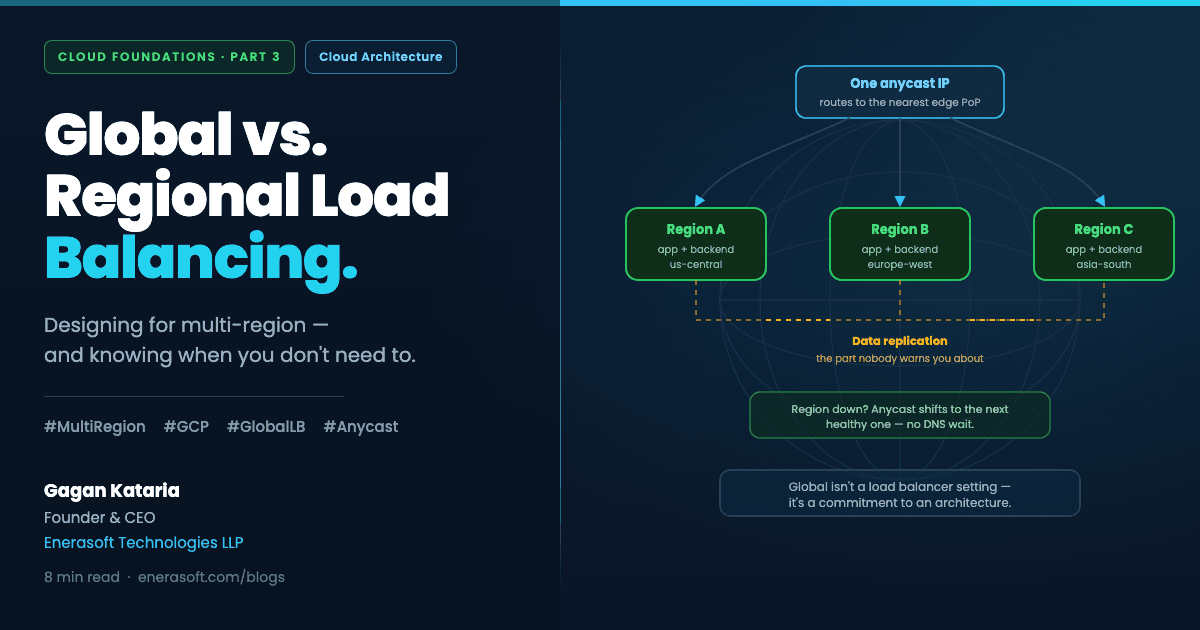
"Should we just go global?" is a question we hear early in almost every architecture conversation — usually from a founder who read that Google Cloud's global load balancer sounds strictly better than the regional one. Faster, more resilient, one IP address for the whole world. Why wouldn't you want that?
Here's the honest answer: because global isn't a load balancer setting. It's a commitment to an entire architecture — one that touches your database, your data compliance posture, and your monthly cloud bill in ways that are easy to underestimate until you're already committed to them.
This post is about making that decision deliberately, with the actual tradeoffs in view — not defaulting to "global" because it sounds more impressive on a slide.
Key Takeaways
- Multi-region is not a single toggle — it's a set of design decisions across four layers that must all work together: traffic entry, backend routing, data replication, and failover.
- Global External Application Load Balancers use anycast to route each user to the nearest of hundreds of Google edge PoPs, adding one extra network hop compared to regional — usually imperceptible on Google's private backbone.
- At low traffic volumes, regional forwarding rules cost less than global ones; at high traffic volumes, the load balancer type becomes cost-irrelevant compared to bandwidth charges.
- The hard part of multi-region was never the load balancer — it's data replication, which is what actually makes multi-region expensive and complex.
- Google's own global deployment archetype pairs a global anycast load balancer with a synchronously replicated database available in every region — the load balancer is only half the architecture.
New to the series? Part 2 covers how to choose the right GCP load balancer for your traffic type — this post picks up from there.
What "Going Global" Actually Changes
It helps to be precise about what the word "global" means in GCP's load balancing product line, because it's doing more work than it sounds like.
A Global External Application Load Balancer uses a single anycast IP that resolves to the nearest of hundreds of Google edge Points of Presence. That PoP terminates TLS, applies your URL map, then talks to your backend over Google's private backbone network — client to PoP to backbone to backend, three hops total (ComputingForGeeks, GCP Regional vs Global External ALB, tested April 2026). A Regional External Application Load Balancer skips the edge PoP entirely — clients reach a regional IP directly over the public internet, and TLS terminates in whichever single region the load balancer lives in.
The practical difference: global gives every user, wherever they are, a fast path to the nearest edge of Google's network. Regional gives you a simpler, single-region setup where nothing is happening anywhere else.
Neither is universally "better." They're built for different situations.
The Case for Staying Regional
Regional isn't the fallback option for teams who can't afford global. For a huge share of real products, it's the architecturally correct choice.
If your main concern is that users in other countries say the site feels slow, the fix that solves most of that problem is Cloud CDN paired with a Global Load Balancer in front of a single-region backend — caching static content at edge locations worldwide, without needing multi-region infrastructure at all (CloudWebSchool, Multi-Region Architectures in GCP, verified March 2026). This is worth sitting with: a huge share of "our international users complain about speed" problems are a CDN problem, not a compute-in-every-region problem. Solve the actual bottleneck before reaching for the more expensive architecture.
Cost reinforces this. Regional forwarding rules cost less than global ones — for a service handling modest daily traffic, the load balancer overhead genuinely dominates the bill. At high request volumes, the cost difference between load balancer types becomes noise next to bandwidth charges (ComputingForGeeks, 2026). In other words: at low traffic, going global costs you real money for capability you're not using. At high traffic, the load balancer choice stops being a cost decision and becomes purely an architecture decision.
Our finding: Most mid-market products we architect at Enerasoft launch regional. It's not a compromise — it's correctly matching infrastructure to where the actual users and actual backends are. Global becomes the right call the moment there's a real second production region, not before.
If you want a second opinion before committing, we're glad to talk through a cloud architecture review.
The Case for Going Global
Global earns its complexity when your users and your compliance requirements genuinely span the world — not when they might, eventually, someday.
GCP's Global External HTTPS Load Balancer routes requests via anycast to the nearest healthy regional backend. If every backend in a region fails, traffic automatically shifts to the next nearest healthy region — with no manual intervention and no DNS propagation delay (CloudWebSchool, 2026). That last part matters more than it first appears. Traditional DNS-based failover — the approach you'd need to hand-build on a platform without native global routing — takes time to propagate as DNS caches expire around the world. Anycast failover doesn't wait for that. It's close to instant, because the routing decision happens at the network layer, not the DNS layer.
This is also where GCP's architecture genuinely differs from some competitors. Cross-region support is native on GCP's global load balancer, reducing architectural complexity, with failover automatic within the load balancer layer itself — better suited to organizations seeking simplified global deployments without hand-built DNS routing (Min, Comparing GCP and AWS Application Load Balancers, 2025). Other clouds often require you to layer additional services — DNS-based routing, a separate global traffic manager — on top of a fundamentally regional load balancer to get similar behavior.
The Part Nobody Warns You About: Data
Here's the tradeoff that determines whether "going global" is actually feasible for your product, and it has almost nothing to do with the load balancer itself.
The compute side of multi-region is straightforward — deploy your app in two places and put a load balancer in front. The hard part is the data layer. Your database has to exist in both regions, stay in sync, and handle the fact that data takes real time to travel between continents. That data replication challenge is what actually makes multi-region expensive and complex (CloudWebSchool, 2026).
This is the piece that "just go global" conversations usually skip. Adding a global load balancer in front of a single-region database doesn't make your product resilient to a regional outage — it just means users worldwide get routed quickly to the one place that can still go down. Genuine multi-region resilience requires your data layer to be multi-region too, and that introduces real engineering complexity: replication lag, conflict resolution, and — depending on your industry — data residency and compliance questions about where customer data is legally allowed to live.
Google's own global deployment archetype pairs the global anycast load balancer with a synchronously replicated database available in every region, such as Spanner in multi-region configuration — with other components of the stack, like caching and object storage, made global as well (Google Cloud Architecture Center, Global Deployment Archetype). Read that carefully: Google's reference architecture for "global" isn't just a load balancer setting. It's a coordinated redesign across compute, data, and caching layers, all moving together.
Multi-Region Doesn't Have to Mean Enterprise-Scale Spending
There's a common assumption that multi-region is only for companies with enterprise budgets. That's increasingly not true, but it does require deliberate design rather than simply duplicating everything.
One team building a multi-region active-active architecture handling 1 million requests per day across 3 regions reported keeping annual costs under $8,000 — an 84% reduction versus a traditional enterprise approach estimated at $50,000+ per year — by using a primary-secondary-tertiary model instead of full 3x duplication, dynamic resource allocation based on real traffic patterns, and shared global services to reduce per-region overhead (DEV Community, Building Multi-Region Active-Active Architecture on a Budget). The lesson isn't the exact dollar figure — it's the design principle: multi-region gets expensive when you duplicate everything uniformly across every region "just in case." It gets manageable when you size each region to what it actually needs and let the architecture flex with real traffic.
A Practical Decision Framework
Ask these questions in order. The first one that clearly applies gives you your answer.
1. Are your users concentrated in one geography? — Stay regional. Add Cloud CDN if international users report slowness — that alone often resolves the complaint without any multi-region infrastructure.
2. Do you have a genuine second production region already, or a concrete near-term plan for one — not a hypothetical future? — Global becomes worth evaluating, but only alongside a real plan for multi-region data replication. A global load balancer in front of a single-region database is not multi-region resilience.
3. Does your industry require data residency in specific geographies? — This usually forces multi-region regardless of traffic volume — but the driver is compliance, not load balancing preference. Plan the data architecture first; the load balancer follows.
4. Is your current single-region setup actually failing users, or does it just feel like it should be more sophisticated? — Be honest here. A lot of "let's go global" conversations start from the second reason, not the first. Architecture decisions driven by what sounds impressive rather than what solves a real problem tend to cost more than they're worth.
Frequently Asked Questions
Does a global load balancer make my application faster for all users?
Not automatically. Anycast routing gets users to the nearest Google edge PoP quickly, but that PoP still has to reach your backend over the backbone — if your backend only exists in one region, users on the other side of the world are still ultimately talking to that one region, just via a faster on-ramp (ComputingForGeeks, 2026). Real speed improvement for distant users requires backends in multiple regions, not just a global load balancer in front of one.
Can I start regional and migrate to global later?
Yes, and for most teams this is the recommended path. Google supports migrating classic Application Load Balancer resources to global external ALB infrastructure, with a 90-day rollback option available as of the May 2025 GA release (Jayendra Patil, 2026) — reinforcing that this migration path is a supported, well-trodden one rather than a risky one-way door.
Is multi-region only worth it for large enterprises?
No — teams have built multi-region active-active architectures serving over a million requests a day for under $8,000 a year by designing deliberately rather than duplicating uniformly. The barrier to multi-region is architectural discipline, not company size.
What's the single biggest mistake teams make when going global?
Treating it as purely a load balancer decision. Multi-region requires coordinated design across traffic entry, backend routing, data replication, and failover — all four layers, not just the load balancer setting (CloudWebSchool, 2026). Teams that flip on global load balancing without addressing data replication end up with a fast, resilient-looking front door and a single point of failure sitting right behind it.
Wrapping Up the Cloud Foundations Series
Across these three posts, we've covered why your application needs a load balancer at all, which GCP load balancer type actually fits your traffic, and now, whether global or regional architecture matches your real situation rather than your aspirations.
The theme underneath all three: none of these are decisions to make by default, or because a bigger company you admire made a different one. VPC, service accounts, and load balancing all reward the same discipline — decide deliberately, early, based on what your product actually needs right now.
If you're mid-decision on your own multi-region strategy and want to think it through with someone who's designed this tradeoff before, we'd be glad to talk it through.
Written by Gagan Kataria, Founder & CEO at Enerasoft Technologies LLP — an AI-powered software and cloud engineering company based in Hyderabad, India. This is Part 3 of the Cloud Foundations series.
Sources
- ComputingForGeeks, GCP Regional vs Global External ALB: Latency, Cost, Certs, tested April 2026, retrieved 2025-07-22, https://computingforgeeks.com/gcp-regional-vs-global-external-alb/
- CloudWebSchool, Multi-Region Architectures in GCP: Patterns, Failover, Cost, and Use Cases, last verified 26 March 2026, retrieved 2025-07-22, https://cloudwebschool.com/docs/gcp/architecture-and-best-practices/multi-region-architectures/
- Min, Comparing GCP and AWS Application Load Balancers, retrieved 2025-07-22, https://h-minn.github.io/posts/en-comparing-gcp-and-aws-albs/
- Google Cloud Architecture Center, Google Cloud global deployment archetype, last reviewed 2024-11-20, retrieved 2025-07-22, https://docs.cloud.google.com/architecture/deployment-archetypes/global
- Jayendra Patil, Google Cloud Load Balancing Types Compared [2026 Guide], retrieved 2025-07-22, https://jayendrapatil.com/google-cloud-load-balancing-types/
- DEV Community, Garrett Yan, Building Multi-Region Active-Active Architecture on a Budget, retrieved 2025-07-22, https://dev.to/garrett_yan/building-multi-region-active-active-architecture-on-a-budget-409n